
Why Does My Anxiety Keep Coming Back?
Why Does My Anxiety Keep Coming Back?
I spent a couple of hours this week doing some training on anxiety and panic attacks. Like I always do after any CPD, I came away thinking about how it fits with the way I work with my own clients. There were some useful techniques that I'll definitely use, but by the time I'd finished, I realised the biggest thing I'd taken away wasn't a new technique at all. It reminded me why I nearly always begin in exactly the same place with every client who walks through my door.
One of the questions I'm asked most often is, "Why has my anxiety come back?" It's such a frustrating experience because it can feel as though anxiety has a mind of its own. You can have a few really good weeks, months or even years where you start feeling more like yourself again and then, all of a sudden, you're back where you started. That's certainly what it feels like anyway.
The more people I work with, the more I think we've been asking the wrong question. Instead of asking, "Why has my anxiety come back?", I think a much better question is, "What is my brain trying to protect me from?" That one question changes everything.
Anxiety Doesn't Usually Come Out of Nowhere
One of the first things I do is map out exactly what's been happening. I want to know what was going on just before the anxiety appeared, what was going through your mind, what you noticed happening in your body and, perhaps most importantly, what happened next. I don't ask those questions because I'm being nosey. I ask them because anxiety rarely appears out of nowhere, even though it often feels like it does.
As we start mapping everything out together, people often stop and say, "I've never realised I do that." That's one of my favourite moments in a first session because the anxiety finally starts making sense!
The Pattern Most People Never See
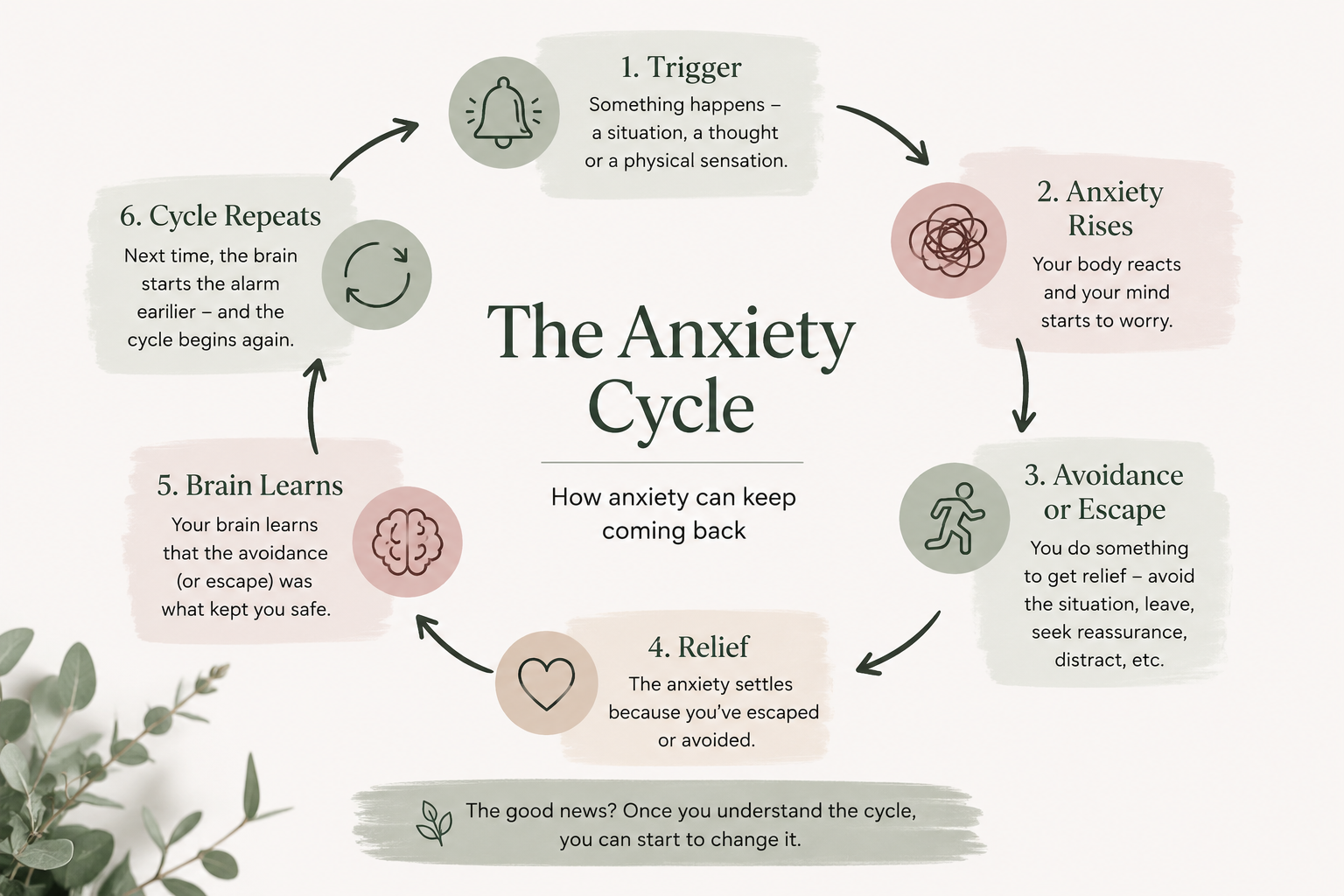
Let's take a really common example like having a panic attack in the supermarket. The next time you need to buy some milk, you pull into the car park and immediately notice your heart beating a little faster. You haven't even got out of the car yet, but your body already feels different. Your thoughts start racing. "What if it happens again?" "What if I can't get out?" "What if I make a fool of myself?" So you decide to come back another day. As you drive away, you feel relieved.
Most people naturally conclude that Tesco has become the problem. But that's not what's happening at all. What heppened is your brain has learnt a pattern!
Our brains are constantly learning from experience. That's one of the reasons they're so good at keeping us safe. They remember what happened yesterday so they can try to protect us tomorrow. Usually that's incredibly helpful. We learn not to touch a hot oven because we remember getting burnt. We learn to slow down on a dangerous bend in the road because we remember what happened last time. The difficulty is that anxiety can be a very convincing teacher.
If your anxiety settles when you leave Tesco, your brain often concludes that leaving is what kept you safe. It doesn't realise that the anxiety would almost certainly have settled anyway. Instead, it quietly files away a message that says, "Next time, let's leave even sooner." Can you see how easy it is for that pattern to repeat?
That's why anxiety often comes back. It isn't random. Your brain is simply repeating something it has learnt!
Why I Spend So Much Time Asking Questions
This is probably where my background in teaching still influences the way I work the most. As teachers, we don't just look at the final answer. We want to understand how somebody got there because that's what tells us what they need next.
Therapy feels exactly the same to me. Before I decide which techniques are likely to help, I want to understand what's actually keeping your anxiety going. Two people can both describe themselves as anxious, yet the reasons they stay anxious can be completely different. One person might avoid situations, another might spend hours overthinking, someone else might constantly seek reassurance and another might become frightened by the physical sensations of anxiety themselves.
If I taught all of those people exactly the same technique, I'd be missing the most important part of the puzzle. That's why assessment is never just a box-ticking exercise for me. It's where we start making sense of your anxiety together.
Understanding Comes Before Techniques
This week's training really reinforced something I've believed for a long time. Techniques matter. Of course they do. But they make far more sense when you understand why you're using them.
I think that's one of the reasons I enjoy Cognitive Behavioural Hypnotherapy so much. We don't simply ask, "How do we reduce anxiety?" We first ask, "What's keeping this anxiety alive?" Once we understand the answer to that question, everything else starts falling into place.
Where Hypnosis Fits In
People are often surprised when I tell them that hypnosis isn't where I start. For me, hypnosis is one part of a much bigger picture.
Once we've mapped out your anxiety and understood the pattern your brain has learnt, hypnosis becomes an opportunity to strengthen new learning. Instead of repeatedly expecting danger, your brain begins practising something different. It starts learning that you can cope, that anxious thoughts don't have to be believed and that uncomfortable feelings don't always mean you're in danger.
That's why I don't see hypnosis as something separate from therapy. It's one of the ways we help your brain build a new pattern.
A Different Way of Looking at Anxiety
Perhaps the biggest thing I'd like people to take away from this article is that anxiety usually makes much more sense than they think it does. It isn't a sign that you're weak. It isn't your brain working against you.
More often than not, it's a brain that's trying a little too hard to protect you. Once we understand the pattern it's learnt, we can start helping it learn a different one.
That's always my aim.
Not simply to help someone feel calmer for an hour, but to help them understand themselves well enough that they leave with the knowledge and confidence to become their own therapist.
Because when you understand the "why", changing the "how" becomes so much easier.
If this article has helped you understand why anxiety keeps coming back, I've created a free hypnosis recording to go alongside it. Rather than simply helping you relax, this recording is designed to reinforce what you've just learnt, helping your brain begin practising a new pattern. You can download it here and listen as often as you like.
Happy listening!
Rachel x